
Introducing the Seattle Animal Watch Data Dashboard
Why Data Matters in Overseeing Government Systems & Why It’s Essential for Seattle’s Animals
Cities run on systems. Some are highly visible: transit, utilities, public safety. Others operate quietly, tucked into the corners of government structures, without the same level of public scrutiny or strategic investment. Animal services fall squarely into this second category.
And yet, the health of these systems tells us a great deal about the wellbeing of a city. They reveal how the government responds to vulnerable populations, how equitably services are distributed, and how effectively resources are deployed. Above all, they show whether the city understands the needs of the people and the animals it serves.
The truth is simple: you cannot oversee what you cannot measure.
Whether we are evaluating government performance, identifying community needs, or driving policy change, data is not a luxury. It is a prerequisite.
Data as a Lens on a City’s Needs
For years, Seattle has operated without a comprehensive, city-wide understanding of animal welfare needs. We don’t have an established or reliable way to estimate the number of companion animals. We don’t know how many people and animals need access to spay/neuter or veterinary services and are unable to obtain them, and whether the barriers they face are due to cost, transportation, or other factors. We don’t know which neighborhoods see the most animal cruelty complaints or have the most stray animals. We don’t know if the Seattle Animal Shelter is adequately funded or staffed. To date, we’ve had to rely on community feedback and anecdotal evidence from volunteers and third party rescues that operate in the area.
In other words, systems are operating…but not necessarily in a way that aligns with the real needs of the city.
High-quality data can change that. It can illuminate patterns that aren’t obvious on the surface. It can quantify gaps in lifesaving, in service delivery, and in resource allocation. And when used strategically, it can guide improvements that aren’t just reactive, but proactive.
As we’ve written in the past, there is a monumental difference between using data to track numbers and using data to improve outcomes. The former is passive, while the latter is how real change happens.
Data as a Driver of Change
Once gaps are quantified, the path forward becomes clearer. A city can:
Adjust staffing levels or funding to meet real demand
Target field operations in neighborhoods that need more support
Expand or redesign volunteer or foster programs
Modernize spay/neuter operations
Create community partnerships where they are most impactful
But this only happens when advocates, policymakers, and government leaders are working from the same source of truth. That shared truth begins with transparency.
Announcing the Seattle Animal Watch Data Dashboard
A public-first tool for understanding Seattle’s animal welfare landscape
Today, we’re excited to launch the Seattle Animal Watch Data Dashboard, the first effort to bring clarity, transparency, and accountability to the state of animal services in Seattle.
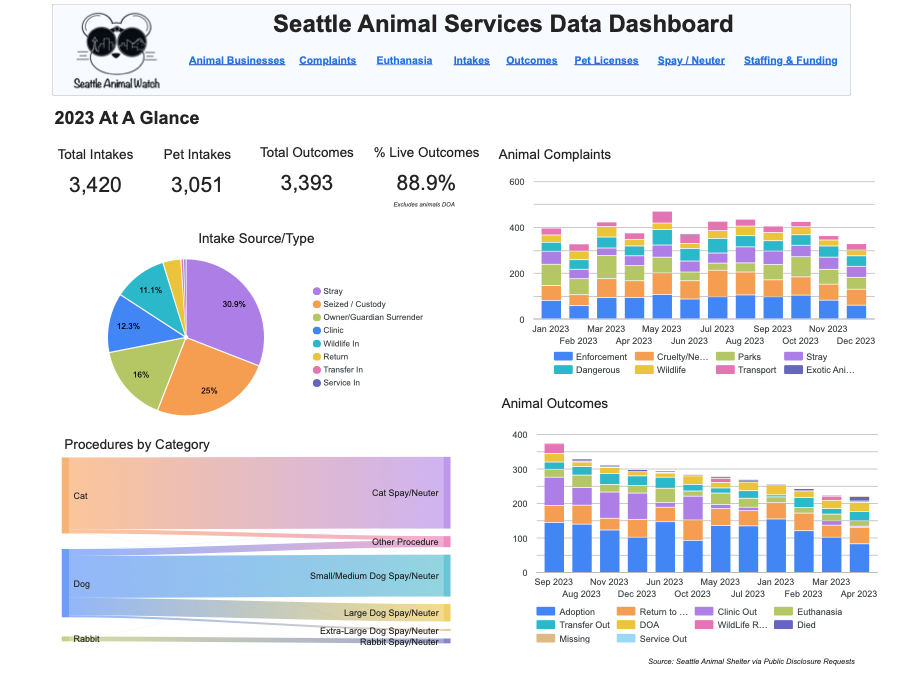
Built from data obtained through the City of Seattle’s Open Data platform and a series of Public Disclosure Requests (more about those in our PDR FAQ), this dashboard offers a centralized view of:
Animal businesses
Animal-related complaints
Pet Licenses
Shelter operations, including:
Animal Intakes
Animal Outcomes
Euthanasias
Field Services
Medical Procedures (e.g. Spay / Neuter)
Staffing & Funding
This is not a final product. It is the first step in a long-term process: a full citywide needs assessment of all animal-related services, something Seattle has never had, but desperately needs.
Data alone does not save animals or change government systems. But, it tells us where the gaps are, and where we must focus our efforts. This is how we begin to ensure that government systems, especially those that impact animals, are effective, accountable, and aligned with the needs of the people and communities they serve.
Explore the dashboard: https://www.seattleanimalwatch.org/data
Our commitment is to continue expanding this dashboard as more data becomes available.


