
The Seattle Animal Shelter's Two-Year Roadmap: "Complete"...But What Does That Mean?
In 2023, following public reporting on safety concerns, communication breakdowns, and volunteer attrition at the Seattle Animal Shelter (SAS), the City brought in outside consultants (Performance Dimensions Group, Dr. Sheila Segurson of Maddie's Fund, and foster program specialist Rachel Jones) to assess the Shelter's operations. Their recommendations became the Two-Year Roadmap: 245 action items covering adoption, foster care, organizational development, process improvement, and technology, to be completed by December 31, 2025.
Seattle Animal Watch has been tracking the Roadmap since its inception. Our first article answered basic questions about what the Roadmap is and how it came to be. Our second examined the foster care items in depth. This third installment answers the question we have been asked most often since the Roadmap's deadline passed: did SAS finish?
According to the Shelter's own tracker, yes, every single item. In early 2026, SAS also published a 'Report to the Community' announcing that 'over 245 action items from the roadmap have been implemented.' According to the notes inside the Shelter's own tracker, the answer is more complicated.
The analysis below is based on two versions of the Shelter's internal Roadmap tracking spreadsheet obtained through public disclosure requests: one dated February 25, 2025, and one from May 2026.
Q: What is the latest status of the Two-Year Roadmap?
A: As of the May 2026 tracker, SAS records all 245 action items (100%) as "Completed."
Between February 2025 and May 2026, 106 items moved to "Completed,” including all 29 items that were still marked "Not Started" fourteen months ago. Much of that final push happened during a leadership transition…the Shelter's new Executive Director was appointed on July 30, 2025, roughly five months before the Roadmap's deadline.
On its face, 245 out of 245 is a remarkable result. So we read every row of the tracker, including the notes column the Shelter uses to document each item's history. That is where the picture changes.
Q: What does the Shelter's own report to the community say?
A: That the Roadmap is done. What it doesn't say is more interesting.
The Shelter's ten-page community report is a readable and often substantive summary of the work: expanded shelter hours, paperless adoptions, a queue management system, a foster plea board, a new volunteer platform, quiet hours and playgroups for dogs, and a revised public website. It also offers the first public outcome figures tied to the Roadmap era: 1,500 adoptions and 1,986 foster placements in 2025. And to its credit, it acknowledges that some items "are transformational changes that relate to organizational culture and will be ongoing, well after this roadmap."
But the report is a narrative, not an accounting. Nowhere in ten pages does it mention that seven action items were cancelled, or that six of them were facility improvements, dropped in favor of pursuing a new building. A strategic decision that reshapes the Shelter's future, and the fate of the animals those items were written for, does not appear in the document written for the community.
Two numbers in the report also deserve scrutiny. First, the report states that "64 action items were completed in the first six months." Sixty-four is exactly the number of items the plan scheduled for the first six months, but because the tracker doesn't record completion dates, that figure cannot be verified. Second, the outcome stats arrive without baselines: 1,500 adoptions and 1,986 foster placements are real work, but without prior-year comparisons the community can't tell whether those numbers represent improvement, decline, or business as usual. According to SAW’s data dashboard, based on public disclosure requests to the City, 1,609 animals were adopted in 2025, down slightly from 1,727 in 2024 but up from 1,482 in 2023.
Q: Does "Completed" mean completed?
A: For most items, yes. For 39 of them, roughly one in six, the Shelter's own notes say otherwise.
We sorted all 245 "Completed" items into categories based on what the tracker itself records.
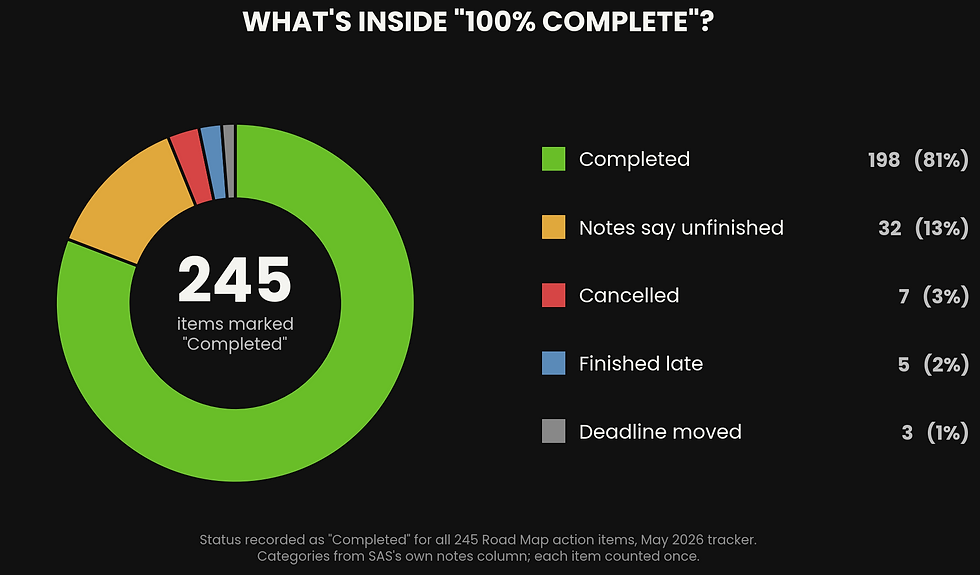
Completed: 198 items (81%). This includes 130 items already done by February 2025 and 68 closed out afterward.
Notes say unfinished: 32 items (13%). Marked "Completed," but the notes describe work that is pending, dependent on other projects, or planned for 2026. Examples below.
Cancelled: 7 items (3%). Marked "Completed," but the notes state a formal decision not to complete them.
Finished late: 5 items (2%). Past their original due date and still incomplete as of February 2025, later closed out.
Deadline moved: 3 items (1%). Closed out only after their timeframe was pushed to a later bucket (see below).
A note on method: with only two snapshots of the tracker, we cannot verify on-time completion for every item…"Completed" here means no visible contradiction in the record, not independently confirmed delivery. If anything, our categories are conservative.
What do the "unfinished" notes look like? A few examples, quoted from the tracker:
An item to review and create cat care SOPs is marked Completed; its note reads "pending completion of cat cleaning SOP's."
A behavior intern program item is marked Completed; its note records a "goal to implement by Jan 2026."
An item on revising foster documents is Completed; the note says the foster manual "will span 2026."
One item's note simply asks: "Is this complete or in process?"
At least 21 items' notes tie completion to Digital Cheetah, the volunteer management platform the Shelter has been rolling out — in several cases the note indicates the underlying work would only happen once that platform was in place.
To be clear: a note describing remaining work does not mean nothing was accomplished. Many of these items show real, documented progress. But a tracker that records delayed, dependent, and abandoned work under the same label as finished work is not a status report, it is a declaration. When the headline number is 100%, the difference matters.
Q: What happened to the facility improvement items?
A: They were cancelled, because SAS is pursuing a new building instead.
Seven items are marked "Completed" with notes that begin "Decision: SAS is not completing this action item…" Six of them concern the Shelter's aging Interbay facility:
Cancelled item | Recorded reason |
Create 1–2 housing units for extra-large dogs | No remodel; pursuing new facility |
Create flex space for adoption counseling / real-life room | No remodel; pursuing new facility |
Need humane location to house feral/unsocialized cats | No remodel; pursuing new facility |
Need less stressful dog housing (separate reactive, fearful, iso, quarantine) | No remodel; pursuing new facility |
Noise reduction: review sound baffling | No remodel; pursuing new facility |
Avoid non-removable barriers that block visual access | No remodel; pursuing new facility |
Use PetPoint adoption application feature | Moving to a paperless adoption counseling approach instead |
The recurring language in these notes states that SAS decided not to invest in remodeling the current building, and that SAS and its parent department, Finance and Administrative Services (FAS), submitted a request to the City to acquire a new facility.
This is consistent with what we reported in our coverage of Mayor Harrell's proposed 2025–2026 budget: FAS plans to use $950,000 from the Shelter's existing capital improvement budget for programming and predesign work on a new animal shelter facility, including stakeholder collaboration and site masterplan analysis. The budget documents acknowledge what staff and volunteers have said for years: the current facility, roughly 10,000 square feet, is too small for the Shelter's operations and has significant maintenance needs.
We think the pivot to a new facility is the right call, and arguably a better outcome than the patchwork fixes the Roadmap originally envisioned. The animals in those seven items' scope (the extra-large dogs, the reactive and fearful dogs, the unsocialized cats) deserve a building designed for them.
But "cancelled for a good reason" is not "completed." Recording these seven items as Completed inflates the headline number and buries a major strategic decision in a notes column. It also means the needs those items addressed remain unmet today, and will remain unmet until a new facility opens...a process that, as of the adopted budget, is at the predesign stage. We will be watching that timeline closely. The community report compounds the problem: it does not mention the facility decision at all.
We reached out to the Shelter in June 2026 to ask about the new facility, and received the following response:
“Approximately $950,000 was allocated in the 2026/2027 budget for this work. We have active request for qualifications’ (RFQ) to identify an architectural consultant and an animal welfare consultant who will help with site and operational planning. The RFQs closes at the end of this month. The results of the work will help us better understand the full costs associated with a new shelter.”
Q: Did any deadlines change along the way?
A: Yes. Eight items had their timeframes or due dates pushed later between the February 2025 and May 2026 versions of the tracker.
Six items moved from the "12–18 months" bucket (due June 30, 2025) to "18–24 months" (due December 31, 2025), including foster photography volunteers, the foster parent Facebook group, e-pay adoption fees through PetPoint, post-placement foster support, and foster training plans. Two more moved from "6–12 months" to "12–18 months." The overall bucket counts shifted accordingly: the February file showed 35 items due at 18 months and 80 at 24 months; by May 2026 those figures were 30 and 87.
Re-planning is normal in any two-year effort, and moving a handful of deadlines is not a scandal. But the tracker does not flag these changes, the due dates were simply overwritten. A reader comparing the final tracker against the original plan would never know the goalposts moved. That is a version-control problem and a transparency problem.
Q: How can the public verify what was actually delivered?
A: For most items, it can't, at least not from the tracker.
The tracker includes a "Product (Y/N)" column intended to record whether an item produced a work product (an SOP, a guideline, a tool), with a link. Of the 245 completed items:
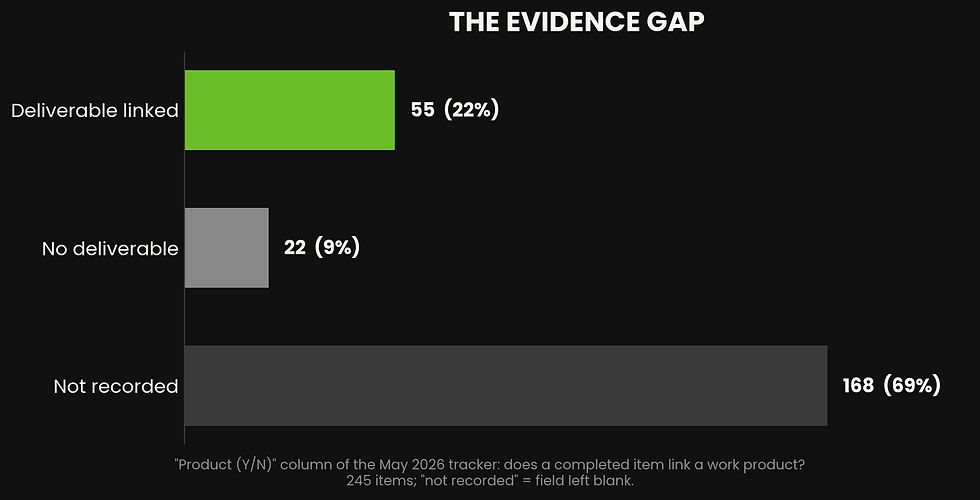
The adjacent approval column, meant to record who signed off on each product, is almost entirely unused, and in several rows contains stray file names rather than approvals, suggesting the columns have drifted out of alignment over time.
Where deliverables are linked, they point to internal SharePoint documents the public cannot access. The community report doesn't close this gap. It offers two outcome statistics (1,500 adoptions and 1,986 foster placements in 2025) but no baselines to compare them against, and no item-level accounting of the 245. We recognize that many action items were process or staffing changes that would not generate a document. But for a Roadmap created in response to public concern about how the Shelter operates, the inability of the public to verify even a fraction of the claimed work is a familiar problem, one we raised in both of our earlier articles.
Q: Who actually did the work?
A: On paper, two thirds of it ran through one desk.
Every action item names a Lead. Across all 245 items, only six roles ever appear...and the distribution is striking:

The Animal Care Manager is Lead on 165 items (two-thirds of the entire Roadmap) on top of running the Shelter's daily animal care operations. The Deputy Director led 44, the Strategic Advisor 25, the Senior Veterinarian 15, and the Field Services Manager 2. No item is led by a line staff member, a coordinator, or a volunteer.
Does that make sense? In one respect, yes: the Roadmap grew out of consultant reports on behavior and foster care, which sit squarely in the Animal Care Manager's portfolio. But concentrating 245 reforms under a handful of managers (and two-thirds under one) is a structural risk the tracker itself illustrates. When we checked whether the flagged items (cancelled or unfinished) clustered under any one Lead, they didn't: the Animal Care Manager, Deputy Director, and Strategic Advisor all show roughly the same 16% flag rate. The unfinished work isn't a performance story about any individual. It is what happens when a reform program this large rides on this few shoulders.
The "People who support" column tells the other half of the story:

Two findings stand out. First, the two most-relied-upon roles in the entire Roadmap are the Foster Coordinator (named on 100 items) and the Behaviorist (82). As we noted in our budget coverage, these are precisely the two positions funded not by the Shelter's base budget but by the Animal Shelter Donation Fund, with sunset dates that the 2026 budget had to extend. The Roadmap's two load-bearing walls are temporary positions on donation money. If the City considers the Roadmap's reforms worth keeping, the staffing that delivered them should be worth funding permanently.
Second, volunteers carried real weight: the Ambassador Team and ASSET Team are each named on 22 items. For a reform effort born partly from volunteer complaints about being shut out, volunteers being written into the work plan is itself a meaningful outcome.
Q: How was the work organized, and around what?
A: Six workgroups, five themes, two consultant reports...and 75 items that never got a home.
Nearly every item traces back to one of two consultant reports: the behavior report (144 items), the foster program report (76), both (21), or the Program Development Group (4). Items were then sorted into five "Opportunity" themes and assigned to workgroups:
Workgroup | Items | Main focus (top report categories) |
Behavior & Medical | 59 | Veterinary care; flow, outcomes & decision-making; adoption |
Volunteer | 47 | Marketing & social media; volunteer program; SOPs |
Leadership | 34 | Organization culture; facility (7 of the 9 facility items, 6 later cancelled) |
Technology | 18 | Foster onboarding and support (Digital Cheetah) |
Community & Culture | 11 | Culture SOPs and agreements |
Field Services | 1 | Field services |
Unassigned | 75 | SOPs, foster, dog care, adoption |
That last row deserves attention: 75 items (31% of the Roadmap) were never assigned to a workgroup, even in the final tracker. Many of them were nonetheless completed, which suggests the workgroup structure mattered less in practice than the tracker implies. But it also means that for nearly a third of the plan, there is no record of which team was accountable.
By theme, the Roadmap looked like this:

Process Improvement dominated: 103 items, 42% of the plan, which matches the single largest report category: "SOPs and Documents" (27 items). To a substantial degree, the Two-Year Roadmap was a documentation project: writing down, standardizing, and getting approval for how the Shelter actually operates. That is less glamorous than new programs, but it addresses the core finding of the original reports: that too much of the Shelter's practice lived in individual heads and inconsistent habits.
Q: Stepping back, did the Roadmap deliver on its five themes?
A: Unevenly, and the unevenness is informative.
Process Improvement (103 items, 14% flagged). The workhorse theme, and largely delivered: lifesaving and pathway protocols, welfare assessment SOPs, euthanasia notification procedures, behavior triage flows, medication administration. The residue is mostly documentation still in review cycles. Verdict: the Shelter operates by written standard far more than it did two years ago.
Adoption (43 items, 16% flagged, 4 cancelled). Adoption counseling, bite-history protocols, meet-and-greet SOPs, and follow-up guidelines were delivered. The cancellations here include the PetPoint application feature (replaced by a paperless counseling approach) and facility-dependent items. Verdict: substantively delivered, with the open question being whether the counseling-based model is measured for outcomes.
Foster (40 items, 25% flagged...the highest rate of any theme). The most ambitious theme and the least finished. Recruitment, training plans, post-placement support, foster data tracking, and the foster manual all carry notes deferring work into 2026 or onto Digital Cheetah. This matches what we found in our foster deep-dive a year ago: foster reform is where aspiration and capacity diverge most. Verdict: real infrastructure built, but the theme the consultants weighted most heavily remains the most incomplete.
Technology (36 items, 14% flagged). Digital Cheetah's rollout closed out dozens of items across themes, and its late arrival explains much of the 2026 carryover elsewhere. Verdict: delivered late, but delivered; the single most consequential dependency in the plan.
Organizational Development (23 items, 13% flagged). Culture agreements, workplace expectations, job descriptions, and workgroup structures were created. This theme also absorbed the facility cancellations via the Leadership workgroup. Verdict: paper foundations laid; whether culture changed is not something a tracker can show...and volunteer and staff experience over the next year will be the real test.
Across all five themes, one pattern repeats: the Shelter finished what it could control internally, and deferred or cancelled what required money, buildings, or new systems. SOPs got written; housing didn't get built. That is not a criticism of staff, it is a map of where the constraints actually are, and all of them point to the same place: the facility and sustained funding.
Q: What genuinely improved?
A: A lot, and it deserves recognition.
Setting aside the flagged items, 198 action items show no contradiction in the record, and the tracker documents real operational change across the Shelter:
The 106 items closed out after February 2025 were concentrated in Process Improvement (41), Foster (22), and Adoption (18), led by the Behavior & Medical and Volunteer workgroups.
Volunteer recruitment notes from late 2024 cite 32 new dog volunteers and 28 new cat volunteers, with strong retention.
The Shelter stood up weekly behavior/veterinary rounds, lifesaving and pathway planning protocols, euthanasia notification procedures, and a suite of foster program documents, items that address some of the most serious concerns in the original consultant reports.
Digital Cheetah, the volunteer platform underpinning many foster and volunteer items, came online in 2025.
The public feels some of this directly. Per the Shelter's community report, shelter hours were expanded, adoptions went paperless, and adopters now get post-adoption support through the Petszel app…the kind of visible, day-to-day changes the Roadmap was supposed to produce.
Two years ago, the Roadmap's fate was uncertain amid a director's resignation. The work continued through an interim period and a leadership change, and a permanent Executive Director is now in place.
The Roadmap moved the Shelter forward. That is not in dispute, and the staff and volunteers who did this work, much of it visible in the tracker's meticulous, candid notes, should be proud of it.
Q: So what is SAW's take?
The Two-Year Roadmap is best described not as 100% complete, but as substantially complete, with important exceptions the Shelter's reporting does not acknowledge.
Our concern is not that seven items were cancelled or that some work slipped into 2026. Plans change; acquiring a better facility will take time. Our concern is that the Shelter's official record does not distinguish between finished, delayed, and abandoned...and that when SAS reported on the Roadmap publicly, that is exactly what happened: the community report announces 'over 245 action items implemented,' with no mention of the seven that were cancelled or the thirty-two whose notes describe unfinished work.
Ironically, the evidence for this article came from the Shelter's own notes column, which is detailed, honest, and often self-critical. The people maintaining this tracker documented reality faithfully. The status column just didn't follow.
We recommend that SAS:
Supplement the community report with an item-level accounting that uses honest status categories (completed, deferred, and cancelled) with completion dates and the rationale for each cancellation or deferral. The narrative report is a good start; the data behind it exists in the Shelter's own tracker. The 32 items with pending work, and the needs behind the 7 cancelled ones, should appear in whatever planning document succeeds the Roadmap, not disappear with it
Report regularly on the new facility effort. The most consequential decision in the entire Roadmap, dropping six facility improvements to pursue a new building, appears nowhere in a document titled "A Report to the Community." The community should hear about the predesign timeline, the site analysis, and what interim measures will address the housing needs the cancelled items leave unmet.
Make the load-bearing positions permanent. The Foster Coordinator and Behaviorist (the two roles named to support more Roadmap items than any other) remain donation-funded positions with sunset dates. Reforms built on temporary staffing are temporary reforms.
Present its findings at a public meeting of the Seattle City Council’s Finance Committee. The Finance Committee oversees FAS and, therefore, it oversees SAS. A public report of the Two-Year Roadmap results would engage lawmakers as well as allow the public to ask questions in a neutral space as opposed to on SAS grounds. This would also provide an opportunity for citizens to learn about the important work SAS does in the city. Perhaps this report would even appear in the often-deaf Seattle media.
Proactively identify next steps. According to the US Census Bureau data released in May, Seattle’s population increased by nearly 11,600 or 1.5 percent from July 1, 2024, to July 1, 2025. The city’s population reached a record 784,800 and it remained the 18th most populous US city. SAS needs to strategize and publicly address the accompanying increase in animal population and demand for services. It cannot rely on the possibility of a new facility at a time of budget shortfalls and the routine de-prioritization of animal welfare.


