We Asked the Shelter About Our Two-Year Roadmap Findings: Here's What They Said

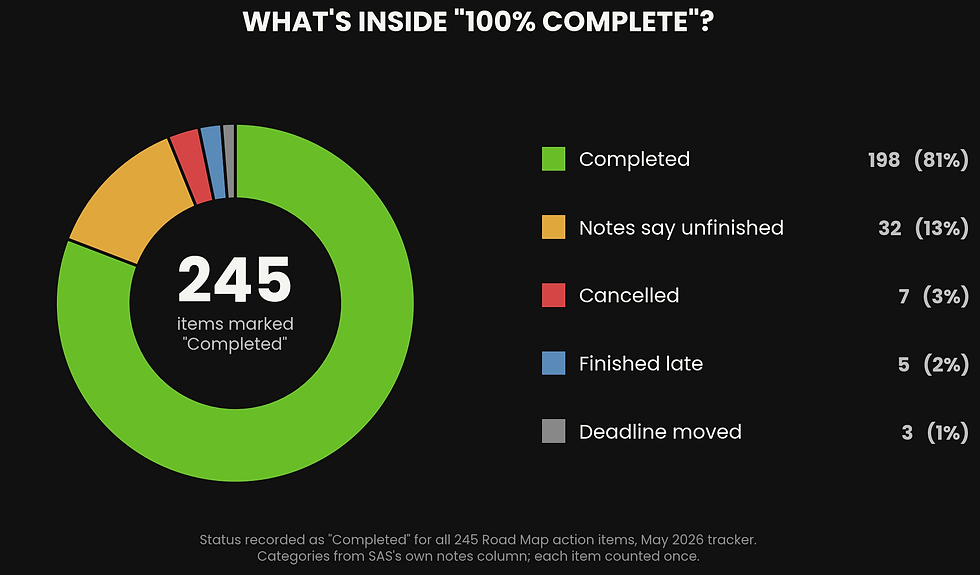
Last month we published a close reading of the Seattle Animal Shelter's Two-Year Roadmap, the 245-item reform plan that came out of the 2023 consultant reports. The Shelter's tracker marked every item "Completed," but the notes inside that tracker, which we obtained through a public disclosure request, told a more complicated story. Seven items were cancelled. Thirty-two carried notes describing work that was still unfinished. And the Shelter's public Report to the Community said nothing about the biggest decision in the data: the choice to stop repairing the current building and pursue a new one.
After the article went up, we sent the Shelter our findings, our questions, and our recommendations. We expected, at most, a short acknowledgment. Instead we got a detailed written reply that took up every point, conceded one, corrected us on another, and shared a few developments the public hadn't heard yet. That reply is worth an article of its own. A watchdog ought to show its work when the organization it covers answers in good faith, and it ought to fix the record where its own framing got ahead of the facts. Both apply here.
Q: What's the latest on the new facility?
This is the real news. When we published, the new facility existed in the record as a single line in a notes column and a predesign item in the City budget. It's further along than that now. The Shelter told us the predesign solicitation, which stalled the first time around when the selection committee couldn't agree on a top team and had to re-advertise, has since wrapped up. An architecture firm and an animal-care consultant have been chosen to lead the predesign.
The Shelter also says it's preparing a public update on where the facility stands, what the next steps might be, and how residents can weigh in on a future site, and that it will add context about the new facility to the Community Report webpage once that update is ready.
That's most of what we asked for. Our original recommendation was that the Shelter report regularly on the facility effort, including the predesign timeline, the site analysis, and whatever interim measures will cover the housing needs the cancelled items leave unmet. A standing public update is the right place for all of that. We'll be watching for it.
Q: Did the Shelter admit the facility decision was missing from its public report?
It did, without much hedging. We'd pointed out that the most consequential decision in the whole Roadmap appeared nowhere in a document literally called "A Report to the Community." The Shelter agreed it may have been a miss, and explained the timing: when the report was written, a new facility was far less certain than it is now, and the report was meant as a high-level summary rather than a line-by-line account.
Q: So were those seven items really just "cancelled"?
Our article counted seven items as cancelled, six of them facility improvements, and made the point that logging a cancellation as "Completed" pads the headline number. We still think that's true as a matter of labeling. But "cancelled" by itself does a disservice to the work behind the decision, and the Shelter was right to say so.
Those seven items took real effort. The Shelter brought in shelter-medicine experts from a university veterinary program to figure out whether fixing the existing building was cost-effective, or even possible. The answer was instructive: improving the current dog housing would have meant losing kennel space. The decision not to remodel came after a long stretch of meetings, budget analysis, and expert consultation.
That changes the picture, and we want to be clear about it. The six facility items weren't dropped because someone lost interest. They were studied and set aside for a good reason, one that points toward a better building than any patch job could have produced. The staff who did that work should get credit for it, not have it vanish behind one word in a spreadsheet. Our complaint was always about the record, not the decision. A choice this big should be visible to the public.
Q: What about the thirty-two "completed" items with unfinished notes?
The Shelter's answer is that the Roadmap was never meant to be a finish line. Some items called for building a process; running and refining that process goes on indefinitely. Others called for recruiting volunteers, and with turnover and steady need, recruiting never really ends, so the notes were written to say as much.
That's reasonable, and it echoes the community report itself, which called some changes "transformational" and "ongoing, well after this roadmap." It also confirms the thing we flagged in the first place. A status column that files continuous, still-maturing work under "Completed" mixes finished work in with work that's still going. The Shelter's explanation tells you why that happened. It doesn't help a reader of the tracker tell the two apart. The fix we proposed, status labels that separate completed from ongoing from deferred, would let the Shelter tell the public exactly the story it told us.
Q: Did the Shelter answer the concern about so much work sitting with one role?
Yes, and the answer was good enough that we're changing our own framing.
We'd found that one role, the Animal Care Manager, was listed as Lead on 165 of the 245 items, and we called that a concentration risk, a reform program resting on too few people. The Shelter explained that the Lead was mainly responsible for handing the work out, not doing it. Because so much of the Roadmap sat under that position's oversight, it made sense for the items to be assigned there, but the work itself mostly ran through workgroups of several people.
One related point from the data still stands, though it's a smaller one: 75 items, about 31% of the Roadmap, had no workgroup listed in the tracker at all. That's not a knock on anyone's performance. It's a gap in the record. If the workgroups are where the accountability actually lived, the tracker doesn't reliably show it, which is one more argument for a public accounting that does.
Q: And the two positions funded by donations?
There's movement here too. We'd flagged that the two roles the Roadmap leaned on most for support, the Foster Coordinator and the Behaviorist, are paid out of a donation fund with sunset dates instead of the Shelter's base budget, and we'd recommended making them permanent.
The Shelter says it has asked for full funding for both positions every year. In the meantime it's done something concrete: a full-time communications and fundraising position recently started, and part of the job is to bring in money and shift costs around so the Foster Coordinator and Behaviorist can eventually be paid from the general fund.
We like this. It's a practical move in a tight budget year. The obvious caveat is that a fundraising hire is a route to permanent funding, not permanent funding itself. Reforms built on temporary staffing are still temporary reforms until the staffing is permanent. We hope that this does not follow other examples of animal services increasingly relying on donations and grants to fund local government operations.
Q: Was the report ever presented to the City Council?
Shared, not presented. We'd suggested the Shelter take its Roadmap results to a public meeting of the Council committee that oversees it, both to put the work in front of lawmakers and to give the public a neutral place to ask questions. The Shelter told us it shared the report with the Mayor's Office and with the chair and vice-chairs of that oversight committee, along with a stakeholder list of adopters, volunteers, donors, City officials, and residents who've opted in through the website.
Handing a document to committee leadership isn't the same as presenting it in public, and we'd still like to see the second thing. A public report-out would get lawmakers' attention, give residents a forum that isn't on Shelter grounds, and maybe even pull in some of the local press that tends to overlook this work. Could the new communications hire be the person to make it happen?
Q: So where does this leave things?
The City still hasn't publicly reckoned with what comes after the Roadmap. Seattle hit a record 784,800 residents in 2025, up almost 11,600 in a single year, and the animal population and the demand for services climbed right along with it. A new facility, even on a hopeful timeline, is years out, and it's being pursued during City budget shortfalls and the usual quiet deprioritizing of animal welfare. The Roadmap was a plan for catching up. What the Shelter needs now is a plan for keeping up, and the public should get to see it.
We're grateful for how readily the Shelter answered. A good watchdog relationship isn't measured by whether we agree, it's measured by whether the questions get real answers. These questions did, and we'll keep asking them.